Contents
Modern communication technologies are no longer just transient luxury tools, but have become the backbone of contemporary human daily and professional life. Reports from prestigious research institutions, such as Pew Research Center and the WHO, indicate that reliance on mobile phones has surpassed traditional boundaries to reach unprecedented levels; individuals spend long hours continuously checking smart screens.
The mobile phone has become an integral part of our daily lives, evolving from a mere voice communication device that receives and sends calls to a comprehensive digital window managing the details of our professional and social lives, occupying most of our time.
See also: Solution for the Screen Not Working – Accessing the Phone Before Repair
Global statistics from major research institutions like Pew Research Center and the WHO indicate that reliance on mobile phones has reached unprecedented levels; individuals spend long hours daily browsing applications and social media, staring at their screens for extended periods.
Despite the tremendous leaps made by mobile phones in facilitating our tasks and bridging distances between individuals, the negatives of phone addiction necessitate a deep discussion about its actual effects on human health and the balance of life.
Our discussion today revolves around the negatives and positives of mobile phones. We will delve into the article to see the real harms of mobile phones according to extensive global studies. And to not get overwhelmed, let’s start with the positives of mobile phones.
Positives and Benefits of Mobile Phones
When looking at the bright side of using mobile devices, we find that the technological revolution led by mobile phones has reshaped the concept of human communication and work. We can mention countless benefits and positives of mobile phones, including:
- Removing geographical barriers: Mobile phones have removed geographical barriers, making it possible to communicate with family, friends, and colleagues at work at a lower cost, regardless of distance.
- Quick access to knowledge: Mobile phones have brought the entirety of human knowledge to a small screen in your hands. A researcher or an ordinary person can gain any type of knowledge while in bed.
- Remote business management: Business sector indicators confirm that smartphones have become essential productivity engines, allowing employees and businesspeople to manage their projects, check emails, and coordinate tasks from anywhere at any time. There are managers running entire companies via their phones.
- Health and emergency services: Applications installed on mobile phones help monitor vital signs and fitness levels, as well as quickly request help and ambulance services in emergencies.
Harms and Negatives of Mobile Phones
In contrast to the positives, medical reports from the NIH warn that excessive mobile phone use leads to negative effects on psychological and physical aspects. Some of the harms of mobile phones can be summarized in the following list:
- Social isolation: Sociological studies indicate that constant engagement with screens creates a kind of “isolation amid the crowd,” weakening face-to-face communication and diminishing the depth of family relationships. In other words, although smart devices can connect people virtually, they have caused a decline in direct face-to-face communication, weakening real family bonds and even friendships.
- Sleep disorders: Research linked to sleep quality confirms that exposure to the blue light emitted from mobile phone screens before sleep suppresses the secretion of melatonin, the hormone responsible for regulating sleep cycles, leading to chronic insomnia and disruption of natural sleep patterns.
- Eye strain and structural device stress: Ophthalmologists and orthopedic doctors have noted a significant increase in cases of chronic eye strain and what is commonly termed “text neck” resulting from continuously bending toward the screen.
- Distraction and decreased productivity: Continuous notifications put the brain in a state of constant alert, weakening the ability to focus deeply and reducing overall productivity in the long term.
Continuous reading and bending toward the screen for long periods strain the neck and shoulder muscles, a phenomenon recently referred to by doctors as “text neck.”
You may also be interested in: How to Format Your Phone Permanently – Format or Reset Your Mobile
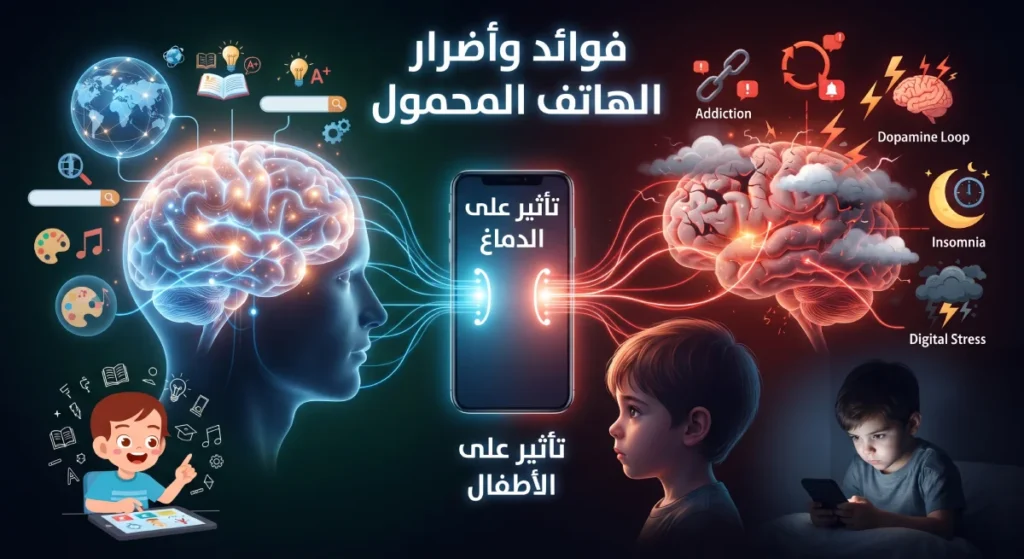
Harms of Mobile Phones on the Brain
The impact of mobile phones on neurological functions has garnered significant interest from researchers in neuroscience and behavioral psychology; studies published in scientific journals, such as those reported by Harvard University research and articles from Psychology Today, indicate notable transformations in the structure and function of the brain.
The impact of continuous mobile phone usage can extend to the brain and cause harms such as:
- Decline in concentration and short-term memory: According to studies in cognitive science, total reliance on mobile phones as an external storage for information, phone numbers, and appointments weakens the brain’s ability to store information, as the brain reduces its effort in memorization by relying on the external source. This phenomenon is described by researchers as “digital amnesia.”
- Dopamine effect and behavioral addiction: Neurological research indicates that every new notification you hear from your phone releases a dose of the dopamine hormone (the chemical reward substance in the brain) in your body, which is very similar to the addiction mechanism of narcotic substances, making users unable to leave the device for extended periods or shortening the time gaps between checking the phone.
- Chronic stress and increased anxiety and tension levels: Analyses of behavioral psychology confirm that constant exposure to negative news and comparing our real lives with the ideal lives presented on social media platforms increases rates of depression and levels of anxiety and stress, creating a fertile environment for mood disorders and depression.
Harms of Mobile Phones on Children
Children are the most vulnerable group affected by the negatives of mobile phones, as their nervous system and brains are in critical stages of development, according to warnings from the AAP. The harms of mobile phones on children can be summarized in the following points:
- Delays in speech and language skills: Studies indicate that early reliance on smart screens deprives the child of developing direct human interaction, often resulting in delays in speech and difficulty acquiring social skills.
- Attention disorders and lack of focus: Research shows that children who spend long hours in front of mobile phones are more likely to face attention issues and difficulties in academic performance later.
- Emotional behavior disorders: Clinical observations confirm that fast-paced digital games program the child’s brain to seek instant rewards, weakening their ability to patience and increasing rates of aggressive and emotional behaviors.
Early reliance on screens reduces the child’s real verbal and social interaction with their environment, often leading to delays in speech and language acquisition.
You may also be interested in: How to Unlock iPhone If You Forgot the Passcode
Tips to Avoid the Harms of Mobile Phones
Here are a set of tips from Wiki Arabic that may help to avoid the harms of phones or assist in reducing dependency on them:
- Try gradually reducing the time spent on the phone (for example, 10 minutes or a quarter of an hour less than the previous day).
- Try to engage more with the surrounding environment, including family, siblings, neighbors, or friends, and observe the results.
- Look at the clock at the first and last use of the phone and calculate the time you spend.
- Try to uninstall social media applications like Facebook or Twitter or any platform you are addicted to.
- Do not use your phone while eating.
- Some social media, like Facebook and YouTube, allow us to set alerts for phone usage time. So try to use these features.
- Try to spend a whole day (for example, on your day off) without your phone at all. Turn off the phone completely and put it in a drawer.
- If the phone is necessary to receive calls and you don’t want to turn it off, try using specific modes on the phone such as extreme power saving modes (without internet).
- Try not to react nervously to provocative comments from people online. Ultimately, responding to them may waste your time.
- If you encounter a problem of harassment or hatred from someone, blocking them is the best solution.
- Remember in the end that you own a smartphone to assist you in your tasks and environment, not to be the arena of your life that you live in.
In Conclusion
In conclusion, the mobile phone remains a smart and innovative tool if used wisely, but it becomes a real danger if dealt with without controls.
Achieving the necessary balance between leveraging the advantages of mobile phones and avoiding their serious harms requires self-awareness and setting clear boundaries for usage times, especially for children, to ensure the mental and physical health of future generations.