Contents
We present a summary of the rules of differentiation in mathematics, with a PDF book at the end of the article that includes solved examples and problems not mentioned in the article, in addition to all the rules arranged in a way that is easy for students to understand.
See also: Basic rules of indefinite integrals
Basic rules of differentiation
First, you must know that the differentiation of a composite term is different from the differentiation of a single variable like x or y. A term, for example, would be x+5 or x2+3x.
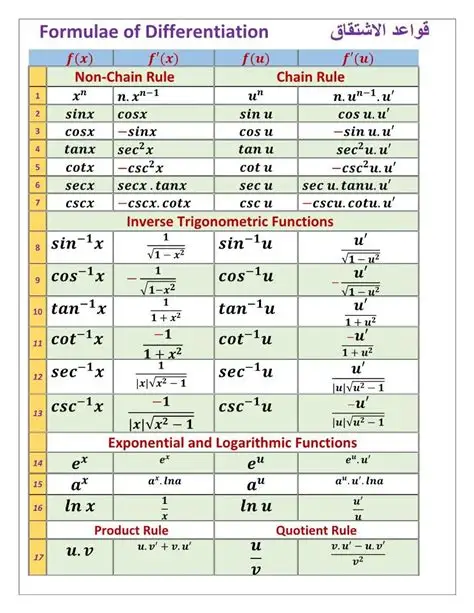
In the image above, the differentiation rules for the variable x are shown on the left in the (non-chain Rule) field, and on the right, the differentiation rules for composite terms (chain Rule). These are some, but not all, of the rules explained. You can refer to them as needed. The following paragraph contains practical exercises.
- The derivative of a constant number = Zero
f(x) = 5 >> f'(x) = 0 - The derivative of x is the coefficient of x. Example:
f(x) = 3x >> f'(x) = 3 - The derivative of a fraction = [ (derivative of the numerator × the denominator) – (derivative of the denominator × the numerator) ] ÷ [the square of the denominator]
f(x) = u/z >> f'(x) = (u'.z-z'.u)/z2 - The derivative of a product of two terms = (derivative of the first × the second) + (derivative of the second × the first)
f(xy) = xy >> f'(xy) = x'.y+y'.x) - The derivative of a variable raised to a power
f(x) = xn >> f'(x) = n . xn-1 - The derivative of a term raised to a power
f(u) = un >> f'(u) = n . un-1 . u' - The derivative of the logarithm x
f(x) = ln x >> f'(x) =1/x - The derivative of the base of the natural logarithm raised to the variable x:
f(x) = ex >> f'(x) =ex - The derivative of cos:
f(x) = cos(x) >> f'(x) =-sin(x) - The derivative of sin:
f(x) = sin(x) >> f'(x) =cos(x) - The derivative of the square root = 1 ÷ the square root itself
In fact, it is a special case of the general case of rule 6 where√x = x½ >> (√x)’ = (x½)’ = x1-½ = x-½ = 1/x½ = 1/√x
Our article is a series of differentiation exercises with solutions**. We will provide various exercises so that you can solve most differentiation cases:
Differentiation Rules with Examples
Fraction Differentiation
Find the derivative of the following fraction or term:
$${\frac{d}{dx}\left(\frac{3x+9}{2-x}\right)}$$
Solution: The rule says the derivative of a fraction = [ (derivative of the numerator × the denominator) – (derivative of the denominator × the numerator) ] ÷ [the square of the denominator]
$${\frac{d}{dx}(\frac{y}{z})=\frac{y’ . z-z’ . y}{z^2}}$$
We apply the rule to our example:
$${=\frac{\frac{d}{dx}\left(3x+9\right)\left(2-x\right)-\frac{d}{dx}\left(2-x\right)\left(3x+9\right)}{\left(2-x\right)^2} :}$$
$${\frac{d}{dx}\left(3x+9\right) = 3}$$
$${\frac{d}{dx}\left(2-x\right) = -1}$$
Now we substitute:
$${=\frac{3\left(2-x\right)-\left(-1\right)\left(3x+9\right)}{\left(2-x\right)^2}}$$
$${=\frac{15}{\left(2-x\right)^2}}$$
Differentiation of a Fraction Raised to a Power
For the differentiation of a term raised to a power, the rule is: If Y is a term raised to the power n, its derivative is:
$${\frac{d}{dx}(Y^n) = n×Y^{n-1}×Y’}$$
Now we come to a composite example with a fraction to apply what we have learned and not forget it. Prove that:
$${\frac{d}{dx}\left(\frac{8x}{5+x}\right)^2\:=\:\frac{640x}{\left(5+x\right)^3}}$$
Solution: Let’s assume 8x/5+x is y. Its derivative will be:
Derivative = 2 × y × y’
$${=2\cdot \frac{8x}{5+x}\frac{d}{dx}\left(\frac{8x}{5+x}\right) : }$$
$${\frac{d}{dx}\left(\frac{8x}{5+x}\right) =\frac{40}{\left(5+x\right)^2}}$$
We learned how to differentiate a fraction in the previous example. Now we substitute:
$${=2\cdot \frac{8x}{5+x}\cdot \frac{40}{\left(5+x\right)^2}\
=\frac{640x}{\left(5+x\right)^3}}$$
Derivative of a Product of Two Terms
The rule states: The derivative of a product of two terms = (derivative of the first × the second) + (derivative of the second × the first)
$${\frac{d}{dx}(y.z)=y’ . z+z’ . y}$$
Here we will mention an example of two terms multiplied by the natural number e. The natural number is treated like any constant, so the rules are nothing new. However, for ease and speed of solving, we remember some rules, such as:
The derivative of ex = ex, meaning it remains the same. This can be proven easily, but there is no place here to mention the proof.
Example: Find the derivative of the following term
$${\frac{d}{dx}\left(1-xe^x\right)^{\:}\:}$$
Solution:
$${\frac{d}{dx}\left(1-xe^x\right)^{\:}\:}$$
$${=\frac{d}{dx}\left(1\right)-\frac{d}{dx}\left(xe^x\right)}$$
The rule states: The derivative of a product of two terms = (derivative of the first × the second) + (derivative of the second × the first)
$${\frac{d}{dx}\left(xe^x\right) = 1\cdot e^x+e^xx}$$
Now we substitute into the term:
$${=0-\left(e^x+e^xx\right)\
=-e^xx-e^x}$$
Derivative of sin, cos, and tan
Let’s look at the set of rules before moving on to the exercises:
- The derivative of sinx is cosx
- The derivative of cosx is
-sinx - The derivative of tanx is
1/cos2x - The derivative of cotx is
-1/sin2x
Find the derivative of the following term:
$${\frac{d}{dx}\left(1-\sin \left(x\right)\right)}$$
Solution:
$${=\frac{d}{dx}\left(1\right)-\frac{d}{dx}\left(\sin \left(x\right)\right)\
=0-\cos \left(x\right)\
=-\cos \left(x\right)}$$
Another example: Find the derivative of the following term:
$${\frac{d}{dx}\left(1-\cos ^2\left(x\right)\right)}$$
As we know from the following trigonometric identity:
$${cos^2x+sin^2x\:=\:1\
1-cos^2x=sin^2x\:}$$
Thus, the term becomes:
$${\frac{d}{dx}\left(1-\cos \:^2\left(x\right)\right)\:=\:=\frac{d}{dx}\left(\sin \:^2\left(x\right)\right)}$$
$${=2\sin \left(x\right)\frac{d}{dx}\left(\sin \left(x\right)\right)}$$
$${=2\sin \left(x\right)\cos \left(x\right): But}$$
$${\mathrm{Use\:the\:Double\:Angle\:identity}:\quad \:2\sin \left(x\right)\cos \left(x\right)=\sin \left(2x\right)}$$
$${=\sin \left(2x\right)}$$
Find the solution to the following exercise:
$${\frac{d}{dx}\left(\frac{1-cos^2x}{cosx}\right)}$$
Solution:
$${\frac{d}{dx}\left(\frac{1-cos^2x}{cosx}\:\right)=\frac{d}{dx}\left(\frac{sin^2x}{cosx}\:\right)}$$
$${\frac{d}{dx}\left(\sin \:\left(x\right)\tan \:\left(x\right)\right)}$$
We apply the product rule of differentiation:
$${\left(f\cdot g\right)’=f\:’\cdot g+f\cdot g’\
=\\frac{d}{dx}\left(\sin \left(x\right)\right)\tan \left(x\right)+\frac{d}{dx}\left(\tan \left(x\right)\right)\sin \left(x\right)\
\\cos \left(x\right)\tan \left(x\right)+\sec ^2\left(x\right)\sin \left(x\right)\
=\sin \left(x\right)\left(1+\sec ^2\left(x\right)\right)}$$