Contents
In our article, we will learn about the laws of probability, types of probability problems, how to solve them, and all the laws that can be used to solve and distinguish between them.
Definition of Probability
Probability is defined as a measure of the likelihood of a random event occurring or not occurring. For example, if we flip a coin in the air, what is the probability of getting heads or tails?
Assuming equal chances of getting heads or tails, we say the probability of getting tails is 50% or 0.5 out of 1. And the probability of getting heads is also 50% or 0.5 due to the coin’s fairness and homogeneity.
Mathematically, we can say that probability equals (Number of Desired Outcomes) ÷ (Total Number of Possible Outcomes)
Here, the probability of getting heads is one outcome, and the total possible outcomes are two (heads and tails), so the probability is 1 ÷ 2 = 0.5
The science of probability has extensive and wide-ranging uses in various fields such as sports predictions, weather forecasts, even in the medical field for blood sample analysis, in embryology to predict the gender of the fetus in the womb, and in commerce to predict sales, etc.
Before delving into examples and practical application, it is essential to mention a set of important definitions regarding probability.
1- Event, Experiment, and Sample Space:
When we conduct an experiment, such as rolling a die, we observe different outcomes. The numbers 1, 2, 3, 4, 5, or 6 can appear. If we are interested in an odd number appearing, such as 1, 3, or 5, then:
- Rolling the die is considered an experiment.
- The odd number we are looking for is called an event.
- All possible outcomes of the experiment are known as the sample space. Which here equals {1,2,3,4,5,6}
2- Possible Outcomes:
Possible outcomes are the results that can occur when we conduct a specific experiment. For example, when flipping a coin, we can get heads or tails. When rolling a die, we can get any number from 1 to 6. Therefore, the number of possible outcomes for a coin is 2, and for a die is 6.
3- Favorable Outcomes:
Favorable outcomes are the results that help us achieve the desired event (or they are the events whose probability of occurrence is required to be studied). If our goal is to get an even number when rolling a die, then the numbers 2, 4, and 6 are the favorable outcomes. These three numbers fulfill what we are looking for.
4- Mutually Exclusive Outcomes (Symmetric Outcomes):
Mutually exclusive outcomes occur when we have completely identical items. For example, balls made of the same material and having the same weight and size. If we mix them in a bag and pull one out, each ball has the same chance of being drawn.
5- Mutually Exclusive Events:
Mutually exclusive events are events that cannot occur at the same time. For example, when flipping a coin, heads and tails cannot appear at the same instant. If one occurs, the other cannot.
6- Independent Events:
Independent events mean that the occurrence of one event does not affect the other. For example, if we flip a coin twice, the result of the second flip is not affected by the result of the first flip. Each flip is completely independent of the other.
7- Exhaustive Events:
Exhaustive events are a set of events where one of them must occur when a specific experiment is conducted. If we have events A, B, and C, it is certain that one of them will occur when the experiment is performed.
These were basic definitions that will help us understand problems in probabilities. Probability is denoted by the symbol P.
Probability Problems
Problem One
When rolling a die once, what is the probability of getting an even number?
Solution: Getting an even number means getting 2, 4, or 6. These three events are mutually exclusive, meaning that when one occurs, the others cannot. Thus, they can be added:
P (even number) = P (2) + P (4) + P (6
The total possible outcomes or sample space = 6 because there are 6 possibilities when rolling a die: {1,2,3,4,5,6}, and their count is 6.
The probability of getting the number 2, for example, is one out of 6 possibilities, i.e., = 1/6. Similarly, for getting the number 4 or 6.
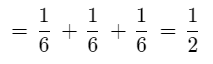
We note that the result is 0.5 or 50%, which is logical because the number of even numbers is half the number of odd numbers on a die, and it is natural for the percentage to be 50%.
Problem Two
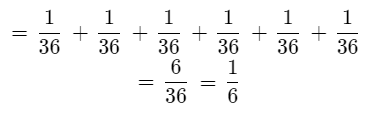
When rolling a die twice, what is the probability of getting two identical faces?
Getting two identical faces means getting (1,1) or (2,2), and so on. Let’s list all possible outcomes (sample space) when rolling a die twice in the following table.
| Probability | Probability | Probability | Probability | Probability | Probability |
|---|---|---|---|---|---|
| (1, 1) | (1, 2) | (1, 3) | (1, 4) | (1, 5) | (1, 6) |
| (2, 1) | (2, 2) | (2, 3) | (2, 4) | (2, 5) | (2, 6) |
| (3, 1) | (3, 2) | (3, 3) | (3, 4) | (3, 5) | (3, 6) |
| (4, 1) | (4, 2) | (4, 3) | (4, 4) | (4, 5) | (4, 6) |
| (5, 1) | (5, 2) | (5, 3) | (5, 4) | (5, 5) | (5, 6) |
| (6, 1) | (6, 2) | (6, 3) | (6, 4) | (6, 5) | (6, 6) |
We notice that the total number of possible outcomes is 36, and the probability of getting (1, 1) is 1/36, as is getting (2, 2).
Therefore, the probability of getting identical faces is:
Problem Three
Two students out of 4 were selected to represent the class at a scientific conference, and students A and B were chosen. What is the probability of selecting these two students together before the selection process, and what is the probability of selecting either student A or B?
Solution: The most important thing in probability problems is knowing the total number of possible outcomes. In this experiment, two students were chosen out of 4. Let’s list the possible outcomes in a table:
Let’s assume the names of the remaining students are C and D, so the sample space is:
P = {AB, AC, AD, BC, BD, CD}
| Probability | Probabilities of selecting two students |
| 1 | A,B |
| 2 | A,C |
| 3 | A,D |
| 4 | B,C |
| 5 | B,D |
| 6 | C,D |
We note that the total possible outcomes are 6, and the probability of selecting students A and B together is one out of 6 possibilities, i.e., 1/6
P(A&B) = 1/6
We denote the probability of two events occurring together by the symbol ∩, which is the intersection symbol. Thus, the above can be expressed as:
PA∩B = 1/6
As for the probability of selecting either student A or B. We denote the probability of one of the two events occurring by the symbol U, which is the union symbol. Thus, the required event is P(A U B)
The probability of selecting either student accompanied by any other student is all possibilities except the possibility C,D, meaning 5 out of 6 possibilities, i.e., 5/6. This is easily solved by examining the possible outcomes. However, mathematically we solve it in the following way:
Cases for selecting student A
PA = {(A,B) , (A,C) , (A,D)}
So the probability PA is 3 out of 6 possibilities, i.e., PA = 3/6
Probability of selecting student A = (Number of Favorable Outcomes) ÷ (Total Number of Possible Outcomes) = 3/6
And the probability of selecting student B
PB = {(B,A) , (B,C) , (B,D)}
So the probability PB is 3 out of 6 possibilities, i.e., PB = 3/6
Here we use the formula:
P(A or B) = PA + PB - PA∩B
And here we subtracted the intersection
Note that we cannot simply add probabilities PA and PB to get 3/6 + 3/6 = 1, which is not 5/6. We must subtract the probability of the intersection, which is A,B, and equals 1/6. Why?
Because the event of selecting one of the two students is not mutually exclusive; that is, the occurrence of one can happen with the occurrence of the other, and thus there are common probabilities.
P(A U B) = PA + PB - PA∩B
= 3/6 + 3/6 - 1/6 = 5/6
This formula P(A or B) = PA + PB - PA∩B is not always correct. You must always understand the problem and determine whether the events are independent or not.
Problem Four
Let’s have a deck of playing cards (52 cards) and draw one card.
- What is the probability of getting a number card?
- What is the probability of getting a Heart card?
- What is the probability of getting the 7 of Hearts?
- What is the probability of getting only face cards?
- What is the probability of getting a Heart or a Club?
- What is the probability of getting a number card or a card from one of the four suits (e.g., Clubs)?
Solution:
First, the total possible outcomes (sample space) from drawing one card are 52 possibilities, which is the total number of cards in the deck.
Therefore, the solution to the first question, getting a number card, is 40 possibilities out of 52, or 40/52, because there are 40 cards with numbers and the rest are face cards.
P Number = 40/52
Probability of getting a Heart card: There are 13 Heart cards (numbers and face cards), so 13/52
Probability of getting the 7 of Hearts: This is a single card in the deck, so there is one possibility out of 52, or 1/52
Probability of getting face cards: There are 12 face cards in the deck, so the probability is 12/52
Probability of getting a Heart or a Club: Here we pay attention to “or.” Since these are independent events and we are drawing a single card, we can add the probabilities. They are independent events, as drawing a single card cannot result in both events occurring simultaneously (a Heart card AND a Club card!).
The number of Heart cards is 13 (including face cards), and the number of Club cards is also 13. Therefore, the probability of getting a Heart or a Club card is 26/52.
Probability of getting a number card or a card from one of the four suits
For this question, there are overlapping (non-independent) probabilities, so we must subtract the common probabilities and apply the formula
P(A or B) = PA + PB - PA∩B
In the first question, we calculated the probability of getting a number card = 40/52, let’s denote it as PA
The probability of getting a Club card is 13/52, let’s denote it as PB
Therefore, the probability of getting a number card from the Clubs is PA∩B =10/52
Thus, the probability of getting a number card or from one of the four suits is
P(A or B) = PA + PB - PA∩B
P(A U B) = PA + PB - PA∩B
P(A U B) = 40/52 + 13/52 - 10/52 = 43/52
Problem Five
A number is chosen at random from 1 to 30. Find the probability that the number chosen is divisible by 2 as well as 3.
Solution: To find the probability that a number chosen at random from 1 to 30 is divisible by both 2 and 3, let’s go through the steps:
Understanding the Conditions
A number that is divisible by both 2 and 3 must also be divisible by their least common multiple, which is 6. So, we need to find the numbers between 1 and 30 (inclusive) that are multiples of 6.
Identifying Favorable Outcomes
The multiples of 6 between 1 and 30 are:
6, 12, 18, 24, 30
There are 5 such numbers. These are our favorable outcomes.
Identifying Total Possible Outcomes
The numbers are chosen from 1 to 30. Therefore, the total number of possible outcomes is 30.
Calculating the Probability
The probability is calculated using the formula:
P(Event)=Total Number of Possible Outcomes/Number of Favorable Outcomes
In this specific case:
P(divisible by 2 and 3)=50/30=1/6
The probability that the number chosen is divisible by both 2 and 3 is 1/6 (approximately 0.1667).
For more explanations, please write in the comments.