
Contents
In mathematics, limits are a fundamental concept used to analyze the behavior of functions as variables approach specific values. Limits are a powerful tool in mathematics, used in differential and integral calculus to understand the behavior of functions more deeply. Today, we’ll talk about some general rules of limits.
When we talk about the limit of a function f(x) as x approaches a specific value a, we use the following formula:
\[\lim_{x \rightarrow b} f(x) = L\]
This means that as the value of x approaches a, the value of f(x) approaches L. Let’s take a simple example:
If we have the function f(x) = 2x + 3, and we want to calculate the limit as x approaches 1:
\[\lim_{x \rightarrow 1} (2x + 3) = 2(1) + 3 = 5\]
Here, we find that the limit equals 5.
But things can be more complex with some functions. Let’s look at another function:
\[f(x) = \frac{ x² – 1}{ x – 1}\]
If we try to calculate the limit directly at x = 1, we will find that the expression becomes undefined (zero over zero). So, we need to simplify the function:
\[f(x) = \frac{ (x – 1)(x + 1)}{ x – 1}\]
We can cancel out (x – 1) (provided that x ≠ 1):
f(x) = x + 1
Now we can calculate the limit:
\[\lim_{x \rightarrow 1} f(x) = \lim_{x \rightarrow 1}(x + 1) = 1 + 1 = 2\]
In this example, we showed how the limit can be different from the value of the function at a specific point.
There is another type of limit known as infinite or undefined limits. For example, if we look at the function:
f(x) = 1 / x
If we want to calculate the limit as x approaches zero:
\[\lim_{x \rightarrow 0⁺} f(x) = +∞\]
\[\lim_{x \rightarrow 0^{-}} f(x) = -∞\]
This means that the limit is not specifically defined, and it tends towards infinity.
Studying the Limit of a Function at Infinity
We can study limits at infinity. Let’s take the following function as an example:
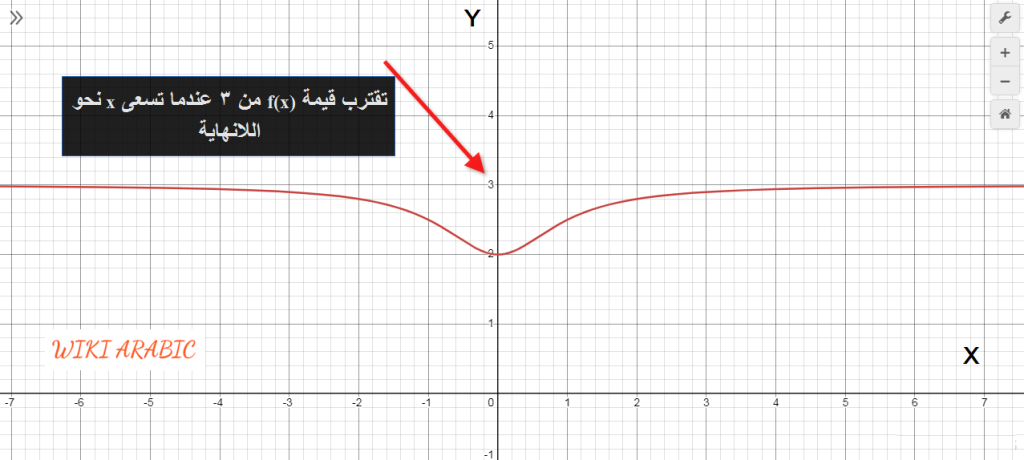
\[f(x) = \frac{3x² + 2}{x² + 1}\]
We want to calculate the limit as x approaches infinity:
We divide each term of the numerator and denominator by the term with the highest power, x2
\[\lim_{x \rightarrow +∞} f(x) =\lim_{x \rightarrow +∞}\frac{ (3 + \frac{3}{x²} )}{ 1 + \frac{1}{x²}}\]
When x approaches +∞, both 3/x² and 1/x² approach 0. So we can write the limit as follows:
\[=\frac{3+\frac{3}{+∞²}}{1+\frac{1}{+∞²}} = \frac{3+0}{1+0} = 3\]
This means that the function approaches 3 as the value of x increases.
Note: Don’t forget to include the condition during the solution, which is that the limit of the denominator must not equal zero.
\(\lim_{x\to a}\left[\frac{f\left(x\right)}{g\left(x\right)}\right]=\frac{\lim_{x\to a}f\left(x\right)}{\lim_{x\to a}g\left(x\right)},\:\quad \lim_{x\to a}g\left(x\right)\ne 0\)
Exercises on the Limits of Functions at Infinity
Exercise 1: Calculate the limit of the following function at \(+\infty\)
\[\lim _{x\to \:\infty \:}\left(-x^3+x^2-x+1\right)\]
Solution: We apply the following rule:
\[\lim _{x\to \infty }\left(ax^n+\cdots +bx+c\right)=-\infty ,\:a<0,\:n\,is\,odd\]
n is odd and a is negative. Therefore, the result is -∞
Exercise 2: Calculate the limit of the following function at \(-\infty\)
\[\lim _{x\to \:-\infty \:}\left(9x^4-12x^3+x+12\right)\]
We apply the following rule:
\[\lim _{x\to \pm \infty }\left(ax^n+\cdots +bx+c\right)=\infty ,\:a>0,\:n\,is\,even\]
Therefore, the limit of the function is \(\infty\)
Exercise 3: Calculate the limit of the following rational function at \(+\infty\)
\[\lim _{x\to \:\infty \:}\left(\frac{7x-1}{x-1}\right)\]
We divide by the highest-power variable, which is x, so the function becomes:
\[=\lim _{x\to \:\infty \:}\left(\frac{7-\frac{1}{x}}{1-\frac{1}{x}}\right)\]
We apply the following rule with its condition:
\[\lim_{x\to a}\left[\frac{f\left(x\right)}{g\left(x\right)}\right]=\frac{\lim_{x\to a}f\left(x\right)}{\lim_{x\to a}g\left(x\right)},\:\quad \lim_{x\to a}g(x) \neq 0\]
Thus, the limit is the limit of the numerator over the limit of the denominator:
\[=\frac{\lim_{x\to \:\infty \:}\left(7-\frac{1}{x}\right)}{\lim_{x\to \:\infty \:}\left(1-\frac{1}{x}\right)}\]
\[=\frac{7}{1} = 7\]
Indeterminate Forms
These are cases where it is difficult to determine the limit of a function, and we need a more in-depth study to find the limit. The indeterminate forms are:
| \[\frac{0}{0}\] | \[\frac{±∞}{±∞}\] |
| \[0 \times ±∞\] | \[+∞ -∞\] |
Exercises on Indeterminate Forms
Exercise 1: Calculate the limit of the following function at 0:
\[f(x)=\frac{ \sqrt{x+4} -2}{x}\]
By calculating the limit, we get 0 over 0, which is an indeterminate form. Therefore, we resort to the method of multiplying and dividing by the conjugate of the numerator:
\[f(x)=\frac{(\sqrt{x+4} -2)(\sqrt{x+4} +2)}{x(\sqrt{x+4} +2)}\]
The identity in the numerator is the difference of two squares and equals the square of the first term – the square of the second term. Refer to the article Basic Algebra Rules and Famous Identities
\[= \frac{({x+4} -4)}{x(\sqrt{x+4} +2)}\]
\[= \frac{1}{\sqrt{x+4} +2}\]
Thus, the limit of the function is:
\[\lim_{x \rightarrow 0} f(x)=\frac{1}{4}\]
Limits for Determining Function Continuity
Limits are also used to determine continuity. A function is continuous at a point if the value of the limit at that point matches the value of the function. For example, if we have a function g(x) = x², it is continuous at any point because it satisfies the condition of continuity.
When dealing with limits, there are important rules such as L’Hôpital’s Rule, which is used to calculate indeterminate limits (such as zero over zero or infinity over infinity):
If we have:
lim(x → a) f(x) / g(x)
And both f(a) = g(a) = 0 (i.e., an indeterminate limit), we can use:
lim(x → a) f'(x) / g'(x)
In this way, derivatives can be used to simplify complex limits.
In short, limits are a fundamental and powerful tool in mathematics that helps in accurately understanding the behavior of functions at specific points or even at infinity.